Updated August 27, 2026
Looking for answers to questions regarding demolition in New York? You've come to the right place.
This guide will go over the most frequently asked questions New Yorkers looking for demolition services face.
Start at the beginning to learn everything there is to know about how demolition in New York City works, or jump ahead to find answers to your specific questions regarding...
- NYC Demolition Permitting Requirements
- Hiring and Working with New York City Area Contractors
- How to Handle Demolition Debris in the NYC Area
Find demolition contractors in the NYC area
Do I need a permit to perform demolition in New York City?
Yes. In New York City, various permits are required for the construction, alteration, or demolition of any building.
However, lucky for you, your contractor is the one in charge of filing them with The Department of Building (DOB).
Learn more about permits:
How long does the permitting process take?
Depending on the complexity of your project, it could take anywhere from one week to three or four in order to obtain all the necessary permits.
How does the process work for obtaining a demolition permit?
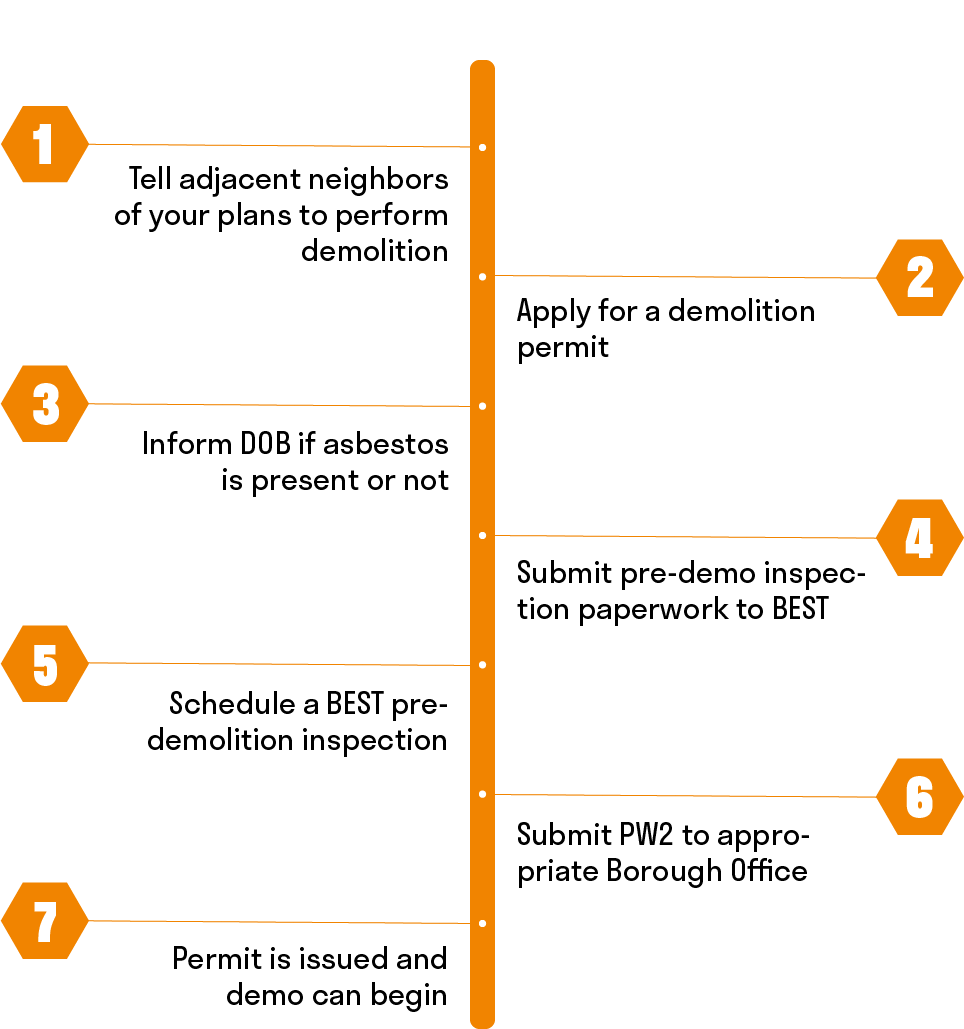
Step 1: Provide required written notice to neighbors.
Before work begins, property owners or contractors must send written notification via certified mail to all adjoining property owners at least 10 business days before demolition commences. Additionally, you must notify the DOB 24 to 48 hours prior to starting work, and notify the DEP at least 7 days prior to starting any asbestos abatement. (NYC Building Code (BC) § 3306.3 / § 3308)
Step 2: Submit job filings online via DOB NOW.
Your licensed contractor must file all initial job applications (PW1), demolition plans, and work permit applications (PW2) electronically using the DOB NOW: Build online portal. Paper drop-offs at DOB Borough Offices are phased out for standard projects. Contractors log in via an official NYC.ID account to submit plans, track processing, and pay filing fees. (NYC Department of Buildings DOB NOW System Rules)
Step 3: Inform DOB if asbestos is present or not.
Then, on behalf of the owner, your contractor must inform the Department of Building if there is asbestos present in your home or not.
- If there is asbestos — the applicant submits an ACP 7 Form, certifying that Asbestos-Containing Material (ACM) is present and describing what will be abated. All ACM must be abated before demolition can begin.
- If there is NO asbestos — the applicant submits a Department of Environmental Protection issued ACP 5, or a DOB-issued Asbestos Exemption Certification Letter (ASB 4 Form).
Step 4: Tenant Protection Plan (TPP) Requirement
If your project involves partial demolition or alterations in a building where at least one dwelling unit will remain occupied during construction, a site-specific Tenant Protection Plan must be prepared by a Registered Architect or Professional Engineer. This plan details egress safety, dust control, and utility maintenance, and it must be filed in DOB NOW and publicly posted in the building lobby prior to permit issuance. (NYC Administrative Code § 28-120.1 & NYC Building Code Chapter 1)
Step 5: Receive the job number.
Once your contractor submits the PW1 form, they're issued a job number.
From there, the number can be entered into the DOB’s Building Information System.
Step 6: Submit paperwork to the Construction Safety Enforcement Unit.
Upon paying the appropriate filing fee, your contractor submits an Application for Inspection Prior to Demolition (Pre-Demolition Report) to the Construction Safety Enforcement Unit (CSEU), which reviews the application and enters it into a demolition spreadsheet.
If large-scale machinery is required, the contractor must submit an Application for Recommendation for Mechanical Demolition.
They review the proposed demolition plan and make recommendations for carrying it out.
Step 7: Schedule a pre-demolition inspection.
After submitting the initial paperwork to the appropriate Borough Office and to the Construction Safety Enforcement Unit, the demolition contractor must also schedule a pre-demolition inspection with CSEU.
The inspection is done in order to:
- Ensure the paperwork on file matches the site being demolished
- Verify the location and size of the building
- Confirm that the structure is vacant
Step 8: Submit PW2 to your Borough Office.
Once the site passes the pre-demolition inspection, your demolition contractor submits a Work Permit Application (PW2) to the appropriate DOB Borough Office to obtain a demolition permit.
Be sure you understand how to fill out the PW2 Form properly.
If everything checks out, the permit is issued and demolition can begin!
Stop Work Orders & Site Safety Rules
Unpermitted demolition, improper asbestos handling, or failure to post required notices can trigger an immediate DOB Stop Work Order (SWO), halting your project and generating civil penalties ranging from $1,250 up to $25,000. For "Major Buildings" (10+ stories or 100+ feet tall), the DOB also requires a licensed Site Safety Manager (SSM) on site throughout active demolition. (NYC Building Code § 3310 (Site Safety Management) & NYC Admin Code § 28-207.2)
Can I hire whoever I want to handle my demolition project?
You can hire pretty much anyone you want to handle your demolition project, as long as they're a licensed demolition contractor in the State of New York.
Hometown can help you find the right contractor for the project.
Who is responsible for what?
There are a few different departments responsible for issuing permits and overseeing various stages of the demolition permit process, so let's break it down...
Department of Buildings (DOB)
- Issues permits for construction and demolition activities in the City of New York
- Inspects plans and sites to verify that appropriate protocols are followed
Fire Department of NYC
- Issues permits for hazardous materials, some of which may be in use on construction and demolition sites
- Inspects construction and demolition sites to ensure compliance with fire safety standards
Department of Environmental Protection
- Oversees and inspects asbestos abatement activities throughout the city, whether conducted independently of or in association with construction or demolition activities
Keep reading about finding the right contractor:
- The Importance of Getting Multiple Quotes Before Hiring a Contractor
- The Science Behind Hiring the Right Contractor
- Understanding the Difference Between a Contractor and Subcontractor
- Why You Should Never Pay Your Contractor Upfront
Find demolition contractors in NYC
What should I do with all the resulting demolition debris?
Whether you're tearing down a building, house, or removing concrete, you're going to have quite a bit of debris to dispose of.
Many contractors may include the price of hauling in their quote, so be sure to ask.
However, if they don't, you'll likely have to haul it to a landfill yourself or rent a dumpster to have another company haul it away for you.
In NYC, a dumpster rental company must be issued registrations by the Business Integrity Commission, authorizing them to collect and remove C&D materials.
Learn more about debris disposal: